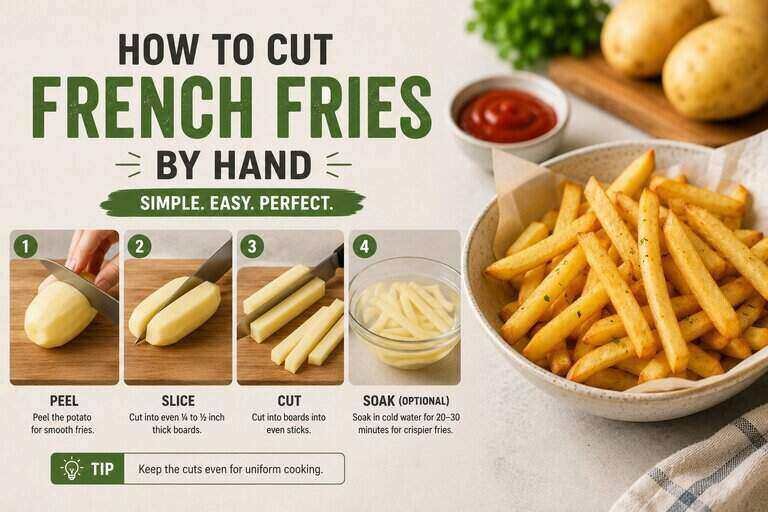
Knowing how to cut french fries by hand means you can go from a bag of potatoes to homemade fries with nothing more than a knife and a cutting board. No gadgets required. It takes a little more time than using a dedicated cutter, but it gives you full control over the exact shape and thickness of every fry.
This guide covers picking the right potato and the two knife cuts that actually matter. It also covers getting the thickness consistent and cooking the results into something genuinely crispy.
Key Takeaways
- Learning how to cut french fries by hand comes down to two knife cuts: batonnet (thick) and julienne (thin)
- Russet or Yukon Gold potatoes give the best texture; waxy potatoes turn out soggy
- A flat “base cut” first keeps the potato from rolling while you slice it, the single biggest safety and consistency fix
- Soaking cut potatoes for 20-30+ minutes removes surface starch and measurably reduces acrylamide formation during frying
- The double-fry method (a cooler first fry, then a hot second fry) produces the crispiest results, by hand-cut or machine-cut fries alike
Why Cut Your Own French Fries?
Cutting your own fries costs less than frozen bags. It also gives you control over thickness, shape, and seasoning that pre-cut fries can’t match.
Cost and Control
A 10-pound bag of russet potatoes runs a few dollars and makes several servings. That’s generally cheaper per serving than a comparable bag of frozen fries. You also decide the exact cut, the seasoning blend, and whether to fry, bake, or air-fry the result.
| Hand-Cut Fresh Potatoes | Frozen Bagged Fries | |
|---|---|---|
| Typical cost | $3-$6 per 10-lb bag | $4-$8 per 32-oz bag |
| Shape and thickness | Fully customizable | Fixed, factory-cut |
| Seasoning | Add anything, any amount | Usually pre-seasoned or plain only |

Hand-Cutting vs. a French Fry Cutter
Both approaches get you to the same place, homemade fries, but they trade off differently on speed, cost, and control.
When Hand-Cutting Wins
Learning how to cut french fries by hand costs nothing beyond a knife you likely already own. It also gives you full control over shape: wedges, thick steak fries, thin shoestrings, or anything in between. You’re never limited to whatever blade grid you happen to own. For one or two potatoes, it’s often just as fast as digging out and washing a separate tool.
When a Cutter Wins
Once you’re cutting more than a few potatoes at a time, a french fry cutter turns minutes of knife work into a single press per potato. The strips come out identically sized every time. It’s the better choice for feeding a crowd, or for anyone who fries potatoes often enough that consistency matters more than the cost of a tool. Our potato slicer buying guide covers current options if you decide to go that route.
Selecting the Right Potatoes
The cut only matters if you start with the right potato.
Best Varieties for Fries
Russet potatoes are the standard pick: high starch, low moisture. That combination fries up crispy outside and fluffy inside. Yukon Golds are a close second, slightly creamier and a bit more buttery in flavor. Waxy potatoes, red-skinned, new, or fingerling varieties, hold more moisture and sugar. They tend to turn out soggy or unevenly browned.
What to Look For
Pick potatoes that are firm and free of soft spots or green discoloration. Choose ones similar in size to each other so your fries finish cooking at the same time. Store them in a cool, dark, well-ventilated spot rather than the refrigerator; cold storage converts starch to sugar and makes fries brown too fast.

Essential Tools for Cutting Potatoes by Hand
You don’t need much for this: a sharp chef’s or santoku knife, plus a stable, non-slip cutting board.
Choosing a Knife
A sharp 8-9 inch chef’s knife is the right tool for this job. A dull knife is both slower and more dangerous, since it requires more force and is more likely to slip. High-carbon stainless steel blades, common on mid-range knives from brands like Dalstrong, Wüsthof, or Victorinox, hold an edge longer between sharpenings than basic stamped blades. Our chef’s knife buying guide covers solid options if you need to buy one.
Cutting Board and Food Safety
Use a stable board large enough that the potato and your cutting hand both fit comfortably. According to the University of Maine Cooperative Extension, nonporous boards (plastic, glass, or composite) resist bacteria better than wood. That’s because they don’t absorb moisture the way porous wood can. Any board with deep, hard-to-clean grooves should be replaced. Wash your board with hot, soapy water after use, and keep a separate board for raw meat if you use one for produce too.
Preparing the Potatoes Before Cutting
A few minutes of prep makes the actual cutting faster and safer.
Washing and Peeling
Scrub the potatoes under running water to remove dirt. Peeling is optional; it’s mostly a texture preference, since the skin adds a bit of chew and fiber. If you do peel, do it before cutting rather than after.
The Base Cut: Your Safety Foundation
Before making any fry-shaped cuts, slice a thin piece off one long side of the potato to create a flat, stable base. This single step prevents the most common hand-cutting mistake: a round potato rolling under the knife. Set the potato flat-side down every time before you cut.
How to Cut French Fries by Hand: The Two Core Cuts
Once your potato has a flat base, there are two classic cuts worth learning. According to Auguste Escoffier School of Culinary Arts, the batonnet measures roughly 1/4″ by 1/4″ by 2 1/2″ long, the classic steakhouse-style fry. The julienne is a finer 1/8″ by 1/8″ by 2 1/2″, closer to a shoestring fry.
Batonnet: The Classic Fry Shape
With the potato flat-side down, slice it lengthwise into 1/4-inch planks. Stack two or three planks at a time and slice them lengthwise again into 1/4-inch strips. Trim the ends square if you want a uniform restaurant look, though it isn’t required.
Julienne: A Thinner, Crisper Fry
The same process, just thinner: slice 1/8-inch planks, stack them, and slice 1/8-inch strips. Julienne cuts cook faster and crisp up more thoroughly since there’s less potato interior to heat through.
Cutting Safely
Curl your guiding fingers inward, away from the blade. Use your knuckles, not your fingertips, as the guide against the knife’s flat side. Let the knife’s weight do the cutting rather than forcing it. Keep your cutting motion slow and consistent rather than rushed. Most of the risk in learning how to cut french fries by hand comes from rushing the first few cuts before your hand finds a rhythm, so slow down until the motion feels automatic.
Achieving Consistent Thickness
Uneven cuts cook unevenly, some fries burn while others stay raw in the same batch.
Why Consistency Matters
Fries within about 1/16 inch of each other in thickness will finish cooking at close to the same time. A big gap in thickness in one batch means picking between undercooked thick fries and burnt thin ones.
Tools That Help
A ruler or a printed cutting guide taped to your board can train your eye for consistent widths. Some cooks find it easier to eyeball the batonnet cut first, since it’s more forgiving of small errors, before attempting the finer julienne, which magnifies any inconsistency. If consistency remains a struggle, a mandoline slicer or dedicated fry cutter removes the guesswork entirely.
Soaking for Crispier, Safer Fries
This step is easy to skip and worth doing anyway. Submerge your cut potatoes in cold water for at least 20-30 minutes; longer, even overnight refrigerated, works too. This rinses away surface starch that would otherwise make fries gummy or stick together in the fryer. There’s a food-science reason beyond texture, too. A study in the Journal of the Science of Food and Agriculture found that washing cut potatoes alone reduced acrylamide formation, a compound linked to high-heat frying, by up to 23%. A 30-minute soak reduced it by up to 38%, and a 2-hour soak by up to 48%. Drain and pat the strips completely dry before cooking; wet potatoes going into hot oil cause dangerous splattering.
Cooking Options After Cutting
How you cook hand-cut fries matters as much as how you cut them.
Deep-Frying (Double-Fry Method)
For the crispiest result, fry twice. First fry at 325°F for 5-8 minutes, until the potato is soft but still pale. Let the strips rest for about 10 minutes, then fry again at 375°F for 2-4 minutes, until golden. The lower first fry cooks the potato through and sets its starch structure. The hotter second fry then drives off surface moisture fast, building a crisp shell while the inside stays fluffy. If deep frying isn’t for you, an electric deep fryer makes the process more hands-off. It also holds a steadier temperature than a pot on the stove.
Oven-Baking and Air-Frying
Toss the cut strips in a thin coat of oil and spread them in a single layer. Roast at 400°F, flipping halfway, for a lower-mess, lower-oil alternative. An air fryer gets closer to deep-fried texture with even less oil; see our guide on cooking french fries in an air fryer for exact timing by thickness.

Serving Suggestions
Classic Toppings
- Salt and black pepper, the simplest option and still the best showcase for a well-cooked fry
- Fresh chopped rosemary or thyme, tossed on right after frying while the fries are still hot
- Garlic powder, smoked paprika, or a cajun spice blend for more kick
Dipping Sauces
- Ketchup, the classic default
- Garlic aioli or plain mayonnaise for a creamier option
- Warm cheese sauce for a heartier side
Season fries the moment they come out of the oil or oven, while they’re still hot. Waiting even a couple of minutes makes seasoning slide right off instead of clinging to the surface.
Troubleshooting Common Issues
| Issue | Likely Cause | Fix |
|---|---|---|
| Soggy fries | Potatoes weren’t dried before cooking, or oil temperature was too low | Pat strips fully dry; keep oil at 350-375°F for the final fry |
| Uneven or ragged cuts | No flat base cut, or inconsistent plank thickness | Always cut a flat base first; slice planks to a consistent width before cutting strips |
| Fries stick together while cooking | Leftover surface starch, or overcrowded fryer/pan | Soak and dry strips before cooking; fry or bake in batches |
Frequently Asked Questions
What’s the difference between julienne and batonnet cuts?
Batonnet is the thicker, classic fry shape at about 1/4 inch square. Julienne is thinner, about 1/8 inch square, and cooks faster with a crisper result.
Do I need to peel the potatoes first?
No. Peeling is optional and comes down to preference. The skin adds a bit of texture and extra fiber if you leave it on.
How do I keep the potato from rolling while I cut it?
Slice a thin flat base off one side first, then set the potato flat-side down. This is the main trick behind cutting fries by hand safely and evenly.
Is soaking the cut potatoes really necessary?
It’s not required, but it noticeably improves crispness by removing surface starch. Research has also linked soaking to a meaningful reduction in acrylamide formation during frying.
What oil temperature should I use?
For the double-fry method, blanch at 325°F, then crisp at 375°F. A single fry at 375°F also works, just with a slightly less thick crust.
Why does my knife slip while I’m cutting the potato?
This almost always means the potato is still round on the bottom. Go back and cut a flat base first; once the potato sits stable and flat-side down, most slipping problems disappear.
Final Thoughts
Once you’ve made the flat base cut and picked between batonnet and julienne, knowing how to cut french fries by hand becomes routine fast. Start with a good russet or Yukon Gold potato and soak your cut strips. Use the double-fry method if crispness is your goal. If you end up making fries often enough that hand-cutting feels like a chore, that’s the signal it’s time to look at a dedicated cutter instead.

Hey, My name is MAMON. I am a SEO content creator and affiliate marketer with over 8 years of experience. I create honest product reviews, in-depth buying guides, and practical how-to articles to help readers make informed decisions. My mission is to provide trustworthy, research-backed content that delivers real value.
Leave a Reply